

Is archery right for me?
The short answer is yes. Archery is one of the few sports that can genuinely work across generations. In some parts of the world, children start very young. In practice, many clubs in Lithuania welcome beginners from around age 12 onward, and adults often continue well into later life. You do not need an athletic background, just the willingness to learn.
Many archers say the sport calms them more effectively than meditation. That is not just romantic talk. When you shoot, your attention narrows to posture, breathing, timing, and the target. Everyday noise tends to fall away on its own.
Bow types: which one should you start with?
Before you buy anything, it helps to understand the main kinds of bows you will come across.
Olympic recurve
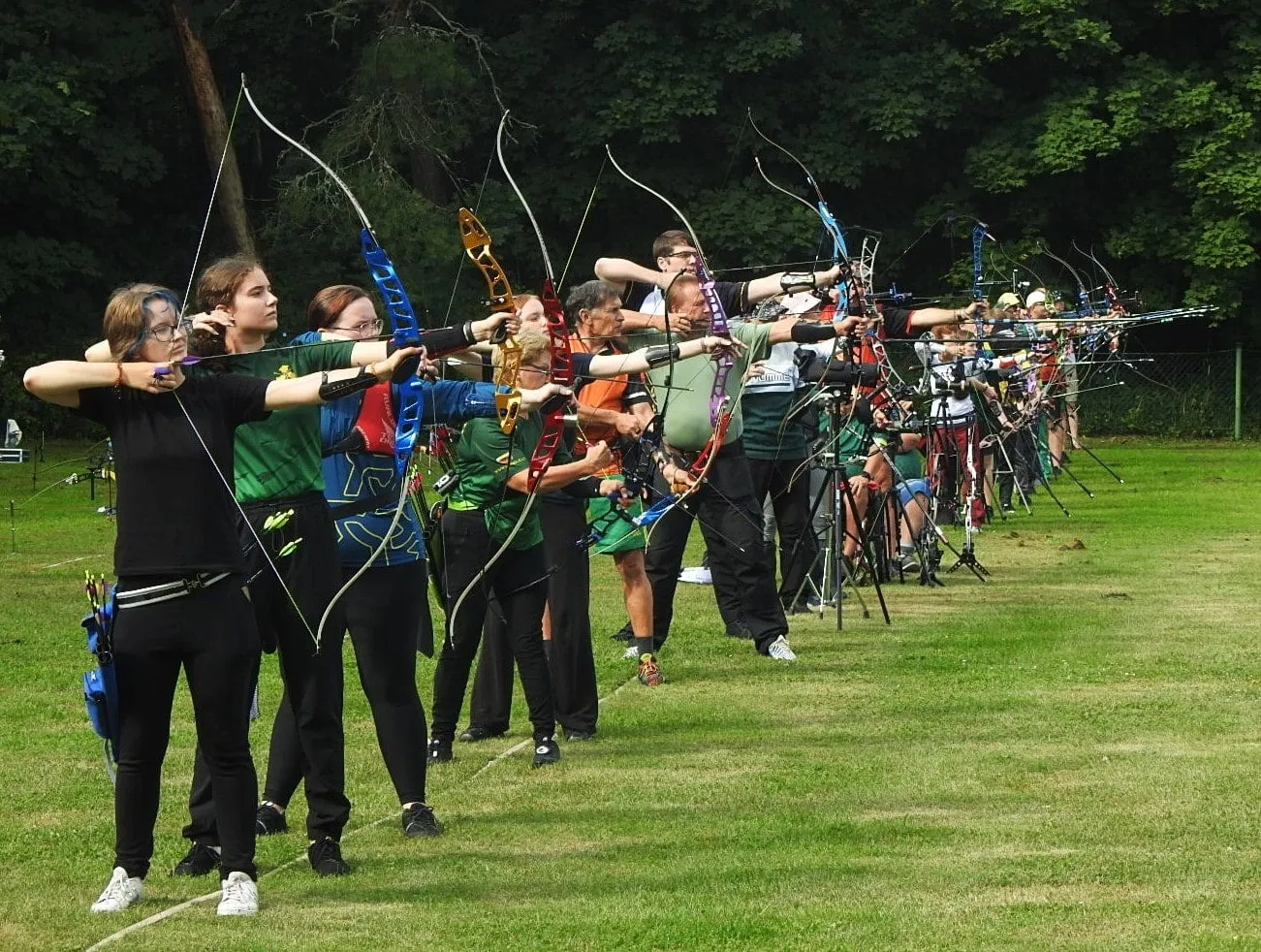
This is the most common starting point for beginners and the bow type used in Olympic competition. It can be adjusted, taken apart, and fitted with accessories such as a sight and stabilisers. For most new archers, it is the best first choice.
Traditional bow
Simpler in construction and closer to historical shooting styles. Traditional bows offer a more instinctive feel and a very different experience, but they are usually less forgiving for complete beginners.
Compound bow
Compound bows use cams and cables, making them easier to hold at full draw and extremely precise. They are popular in target shooting and hunting, but they are usually not the best first step for someone with no foundation at all.
Best beginner recommendation: start with an Olympic recurve. It helps you build proper technique, allows room for progression, and gives you the strongest base for any later transition.
What equipment does a beginner need?
The good news is that for your first session, you usually do not need to buy anything at all. Most clubs provide beginner equipment, including a bow, arrows, and protective gear. Buying your own setup only makes sense once you know you want to continue.
When that time comes, the key pieces are:
- Bow, chosen for your draw length, build, and strength
- Arrows, matched to your setup and draw length
- Arm guard, to protect your bow arm from string slap
- Finger tab or glove, to protect the fingers drawing the string
- Quiver, to hold arrows during training
- Target setup, which the club will usually provide
A basic starter kit can cost roughly 150 to 400 euros, but there is no need to spend that straight away.
What to expect from your first lesson
Many people imagine their first session will feel awkward or overwhelming. In reality, archery is often one of the friendliest sports for newcomers.
- Safety briefing, where the coach explains the core rules of the range
- Stance and grip, learning how to stand and hold the bow properly
- First shots, usually from a short distance so technique comes first
- Corrections, with the coach helping you improve small details
- Practice, where confidence starts to grow very quickly
Safety rules you should never ignore
- Never point a bow at a person, even without an arrow.
- Only shoot when the coach or range lead gives the signal.
- Only walk to the targets when everyone has finished shooting.
- Arrows should only be nocked while you are on the shooting line.
- Never draw and release a bow without an arrow unless explicitly instructed to do so.
The five basics of shooting technique
Stance
Stand side-on to the target, feet shoulder-width apart, body balanced and relaxed.
Grip
Hold the bow lightly. Over-gripping can throw the shot off line.
Draw
Draw smoothly back to a consistent anchor point near the face.
Aim
Focus on the target and keep your alignment consistent.
Release and follow-through
Release cleanly and stay steady after the shot instead of collapsing immediately.
The fastest way to improve: learn with a coach
Reading helps, but real progress happens on the range. A coach can spot mistakes you will not notice on your own, help you avoid bad habits, and make sure you start with equipment that actually suits you.
- You improve faster because feedback is immediate.
- You reduce the risk of injury and poor habits.
- You do not need to buy gear before you know what fits.
- You get a clearer picture of which style of archery suits you best.
Start with Klaipėda Archers
Our coaches have more than 40 years of experience in archery and are happy to work with complete beginners as well as more experienced archers. The club is based in Smiltynė, in the UNESCO-listed Curonian Spit.
- ✅ First trial session is free
- ✅ Beginner equipment is provided
- ✅ Group training on weekdays, 18:00–19:45
- ✅ Private sessions by arrangement
How to improve after the first few sessions
- Be regular. Two or three shorter sessions per week are better than one long, inconsistent one.
- Listen to coaching. Small adjustments can make a big difference to accuracy.
- Watch your shot patterns. They reveal habits faster than you think.
- Do not rush into buying the wrong bow. Let your coach help you choose.
- Watch competitions. You will learn a lot just by observing experienced archers.
Conclusion
Archery is not complicated, but it does reward patience and repetition. The hardest part is usually just taking the first step. Once you do, the rest becomes much easier.
If you are in Klaipėda or planning to visit Smiltynė, our club is a great place to start. Your first session is free, the coaching is strong, and the setting is one of the most beautiful in Lithuania.